 ABA Fieldwork Tracker

The short answer#
The Behavior Analyst Certification Board (BACB®) once published its own spreadsheet for logging fieldwork hours. If you are looking for the BACB Experience Tracker, here is what happened to it: the BACB introduced it in its March 2018 Newsletter, renamed it the Fieldwork Tracker in 2019, and it is no longer on bacb.com. When we checked on October 14, 2026, its old links redirected to a BACB video page about documenting fieldwork hours.
What to use now: a tracker built for the rules you will apply under. The newest BACB version we found dates from 2019, before the 2027 changes, so an old copy can do its arithmetic perfectly and still be wrong. ABA Fieldwork Tracker is a free fieldwork tracker that does what the old spreadsheet’s month-by-month tab did, as you log, under both the earlier and the 2027 rules. Below: the short history, what changed, and what your records need now.
What the BACB’s tracker was#
The tracker arrived with a bigger change. In March 2018 the BACB announced a monthly experience system, required for all hours from January 1, 2019, with a minimum of 20 and a maximum of 130 hours a month. To help trainees and supervisors with it, the BACB said it had developed new resources, “including the Pre-Experience Checklist, Experience Tip Sheet, and Experience Tracker.”
The tracker was a spreadsheet: a log for your hours, plus a Data Analysis tab that added them up month by month. The file itself called it “a free optional resource.” Version 2.0, dated April 9, 2019, changed “Experience” to “Fieldwork” in the name and added a choice of applying before or after January 1, 2022. Version 2.1, dated June 28, 2019, adjusted a formula for months of exactly 130 hours. That is the newest version we found in archived copies of the BACB’s site.
Where it went#
The tracker is no longer on bacb.com. On October 14, 2026, we followed its old addresses. The tracker’s information page and its download link each redirected, in a few steps, to Documenting Fieldwork Hours, a BACB video post from August 2021 about the supervision contract, your documentation system, and the verification forms. The addresses where the spreadsheet itself used to sit returned “page not found.” We could not find a BACB announcement about the change, so we will not guess at the reason. The BACB still publishes a Fieldwork Checklist and Tip Sheet (updated 06/2026).
Files with the same name still turn up on marketplace and document-sharing sites. The BACB does not publish them, and a copy you find today is most likely version 2.1, an older one, or someone’s edit of one.
Why an old copy gets 2027 wrong#
Version 2.1 was finished in June 2019, almost three years before the BACB’s March 2022 Newsletter set out the changes for 2027. Which rules apply to you depends on when you apply, not when you started, and applications on the 2027 rules use the 2027 Monthly and Final Fieldwork Verification Forms. Here is what changed for your records:
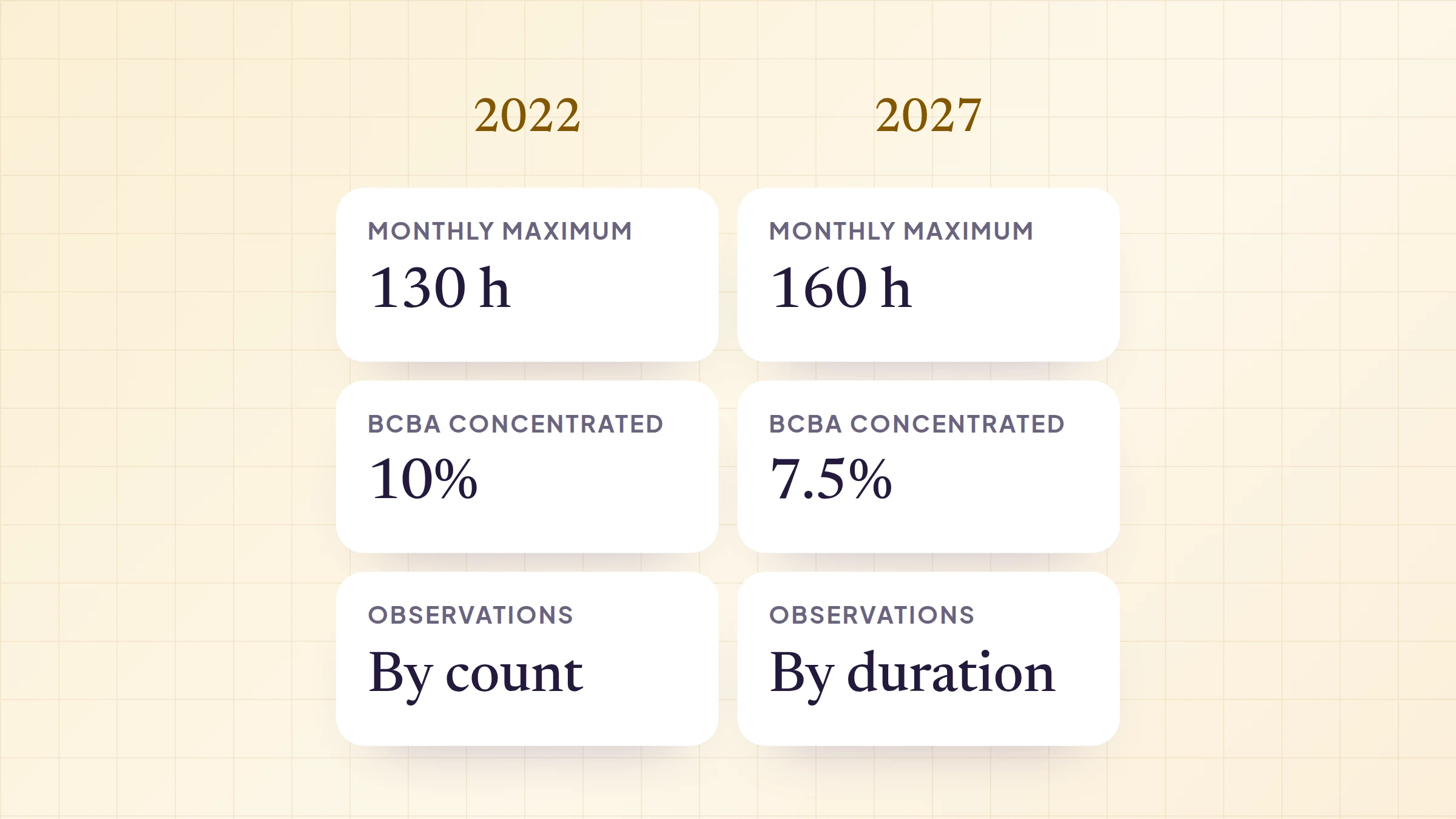
- Hours in a month: 20 to 130 under the 2022 rules, 20 to 160 under the 2027 rules.
- Observation by your supervisor: at least one a month before, 60 cumulative minutes a month on supervised fieldwork or 90 on concentrated under the 2027 rules.
- Supervisory contacts: four a month (supervised) or six (concentrated) before, no count under the 2027 rules.
- Supervision in a BCBA® concentrated month: 10% before, 7.5% under the 2027 rules.
- BCaBA® concentrated total: 1,000 hours before, 800 under the 2027 rules.
Some things do not change: at least 5% of your hours in each supervised fieldwork month must be supervised, and at least 60% of BCBA fieldwork hours (40% for BCaBA) must be unrestricted. So a spreadsheet built for 2019 may stop a month at 130 hours, look for an observation count instead of minutes, or flag a missing contact the 2027 rules no longer ask for. Every change is listed in our comparison of the 2022 and 2027 BACB standards.
What to use now: a month that adds itself up#
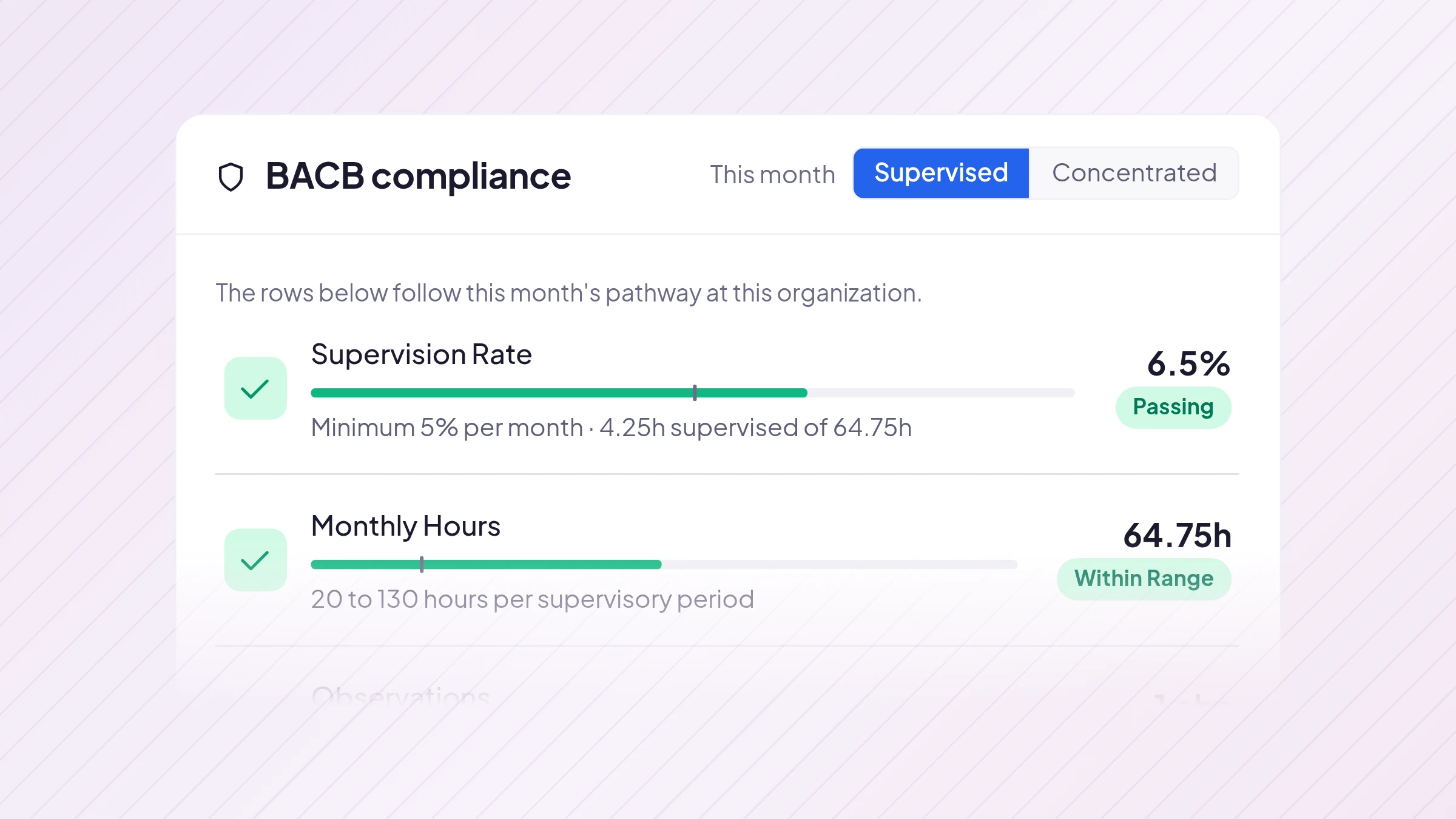
The old tracker split the job in two: you typed hours into one tab, and another tab did the month’s math. In ABA Fieldwork Tracker it is one view that updates as you log. Each entry lands with its independent, supervised and group hours, restricted time marked, and its observation minutes, and the month’s totals move with it.
That trainee is on the 2027 rules for BCBA supervised fieldwork, so the month needs at least 20 hours, at least 5% of them supervised, and 60 minutes of observation. The app checks those as each entry lands, and the month reads On track once it meets them. What it does for you:
- Both rule sets: the earlier rules and the 2027 rules, so you are checked against the ones you will apply under.
- Every month’s supervision percentage, against your pathway’s minimum.
- Observation minutes toward the 60 or 90 a month the 2027 rules ask for.
- Supervised and concentrated months, each kept as its own type, with a mixed BCBA or 2022 BCaBA total counted by the BACB’s multiplier.
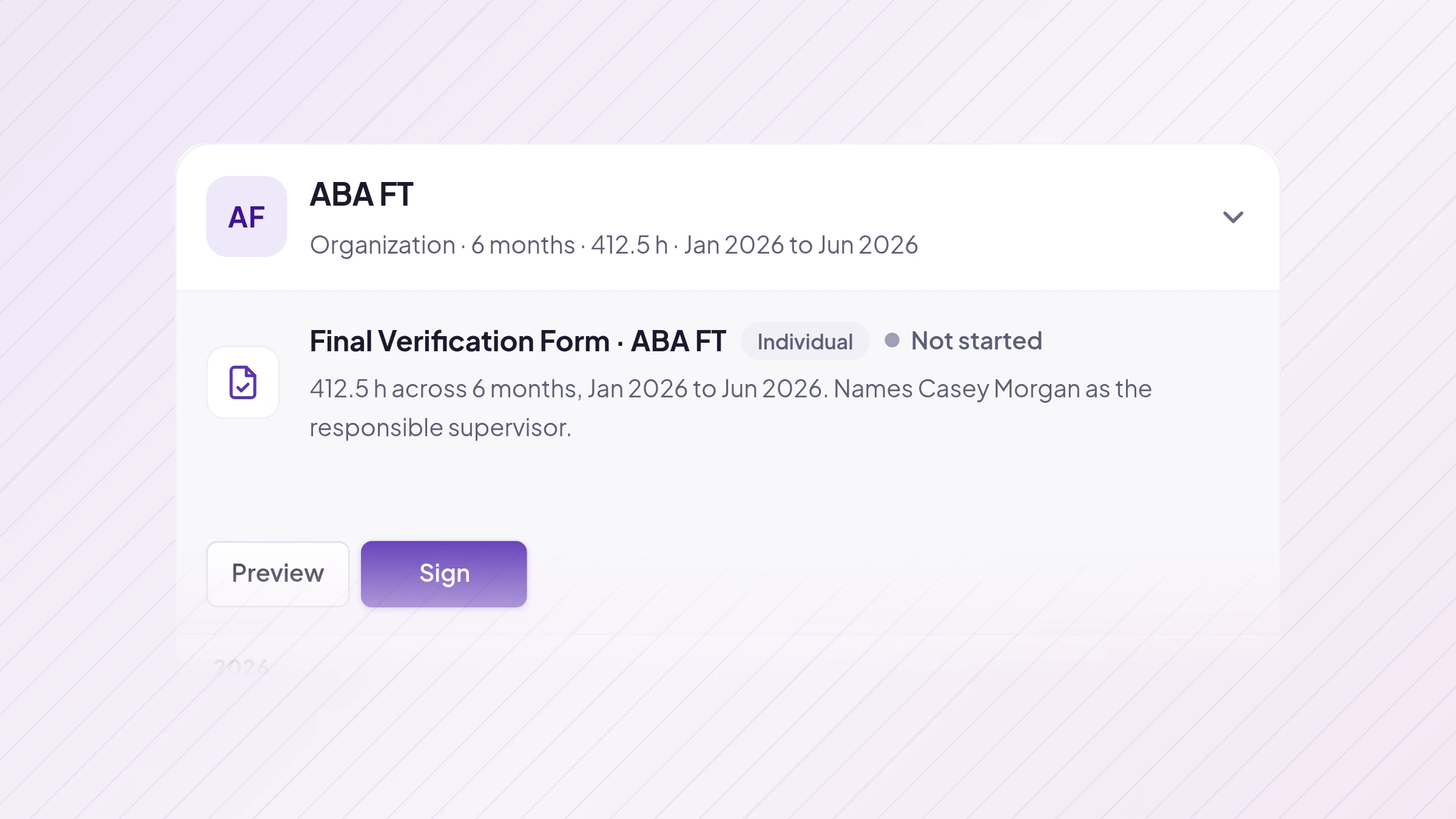
- Your monthly and final verification forms go to your supervisor to review and sign in the app. Supervisor accounts are free.
- Your records stay yours, stored in line with the BACB’s seven-year retention requirement, wherever you work next.
It shows where each month stands; it never blocks an entry, and whether to sign a month stays with you and your supervisor. The compliance checks page shows every check in detail.
Does the BACB require a particular tracker?#
No. The BCBA Handbook (updated 06/2026) gives supervisors and trainees “the flexibility to develop their own system for documenting ongoing supervision and fieldwork in a way that demonstrates adherence to all relevant requirements and the Code.” The BACB is just as clear that it stands behind no product: its January 2026 blog post on fieldwork says it “does not work with or endorse any of these products.” That includes ours.
What the BACB does require is that your documentation system captures every requirement below, and that you and your supervisor each keep all fieldwork documentation for at least seven years. One tip from its Fieldwork Checklist and Tip Sheet: avoid storing your signed forms “on a computer where access could be limited (e.g., a work computer).” If you are still weighing a spreadsheet, read is a BACB fieldwork tracker spreadsheet enough? first.
What your records need under the 2027 rules#
This is everything the BACB’s current documents ask your fieldwork records to hold for an application on the 2027 rules, with the earlier rules noted where they differ. It is the list ABA Fieldwork Tracker is built around, and the list to hold any other option to.
For every supervision contact
- The date, the start time, and the end time.
- The fieldwork type (supervised or concentrated) and the supervision type (individual or group).
- The activity category, restricted or unrestricted. A group hour gets a category too.
- A short summary of the supervision activity.
- A real client behind every activity. All fieldwork hours must be related to specific client programming; reviewing case studies or hypothetical scenarios does not count.
For every month (a supervisory period is one calendar month)
- Total fieldwork hours, from 20 to 160. A month under 20 hours counts for nothing. Under the earlier rules, the maximum is 130.
- Restricted, unrestricted, supervised and independent hours. Every session, contact and observation carries an activity category, so restricted and unrestricted hours add up to the month’s total. Supervised hours include your meetings with your supervisor.
- The supervision percentage. Supervised hours divided by total fieldwork hours for that month: at least 5% for supervised fieldwork, 7.5% for BCBA concentrated, 10% for BCaBA concentrated. Each month is tested on its own. If a supervised fieldwork month falls below 5%, you and your supervisor may reduce its independent hours until the percentage is met; concentrated hours may not be prorated or adjusted.
- Individual and group supervision. The Handbook says “at least 50% of the supervision meeting time must be individual supervision” and that “group supervision hours may not exceed half of the total supervised hours” in each supervisory period. A group has 2 to 10 trainees.
- Observation minutes. Your supervisor observes you with a client for at least 60 cumulative minutes in a supervised fieldwork month, or 90 in a concentrated month. Under the earlier rules, one observation a month was the minimum.
- The month’s fieldwork type. A month counts as concentrated only if its form meets the higher supervision percentage and observation duration. Every form records your actual hours.
- One Monthly Fieldwork Verification Form (M-FVF) per supervisor or organization, signed by you and your supervisor by the last day of the calendar month after the month it covers; if you miss it, none of that month’s hours are eligible. Our free verification form generator fills in the current versions.
Across all your fieldwork hours
- Your running total against your pathway. BCBA: 2,000 hours of supervised fieldwork or 1,500 of concentrated. BCaBA: 1,300 supervised, or 800 concentrated under the 2027 rules (1,000 under the earlier rules). The Final Fieldwork Verification Form (F-FVF) records the two types in separate sections, and the fieldwork hour calculator shows how much is left.
- Your unrestricted share: at least 60% of your total fieldwork hours for BCBA, 40% for BCaBA, measured across all your hours, not month by month.
- Your five-year window: all of your fieldwork falls within five continuous years.
- An F-FVF for each supervision relationship, signed at the end of the relationship. Your pathway’s page has every number for your combination.
- At least seven years, by both of you. Your signed monthly forms are not submitted with your application, so they live in your records.
Months in an old copy? Bring them with you#
If you kept months in a copy of the BACB’s tracker, you do not have to start over. You can import past fieldwork hours into ABA Fieldwork Tracker as one summary per month and organization, from your signed monthly forms and your own records, and your progress picks up where you really are. From then on, every month is checked as you log it.
The tracker the old spreadsheet was trying to be.
Log a session and the month checks itself: hours, supervision percentage and observation minutes, under the earlier or the 2027 rules. Free, with no ads.
Try it with one month#
Registration is free, there are no ads, and no card is needed. Log one real month and you will see its hours, supervision percentage and observation checked against your rules as you go. Then invite your supervisor; supervisor accounts are free too. Create your free account.
ABA Fieldwork Tracker is an independent tool and is not affiliated with or endorsed by the Behavior Analyst Certification Board®. Always consult the current BACB® Handbook and your supervisor for authoritative guidance on fieldwork requirements.