 ABA Fieldwork Tracker
The short answer#
Every BCBA candidate asks it early: how long does BCBA fieldwork take? The BACB’s own planning table answers at both ends. At the 160-hour monthly maximum of the 2027 standards, supervised fieldwork takes as little as 1 year and 2 weeks, and concentrated supervised fieldwork as little as 9 months and 2 weeks. At the slow end, either one can stretch to five years. Where you land in between comes down to one number: the hours you log each month.
This guide covers fieldwork only. It doesn’t estimate how long your degree, your coursework, the BACB’s application processing or the exam will take; those depend on your program and on the BACB. What it does give you is the month-by-month math for BCBA fieldwork hours, and BCaBA too, on every pathway under the 2027 standards, plus the rules that decide how fast the months can go.
The BACB’s own planning table#
The BACB publishes the outer limits itself. Page 2 of its Fieldwork Checklist and Tip Sheet (updated 06/2026) sets out the longest and shortest time frames “under the 2027 requirements.” Here it is, row for row:
| Tip Sheet table | Longest time frame allowed | Shortest time frame possible |
|---|---|---|
| BCBA 2027 Supervised Fieldwork: 2,000 hours | 5 years, at ~34 hours per month | 1 year, 2 weeks, at 160 hours per month |
| BCBA 2027 Concentrated Supervised Fieldwork: 1,500 hours | 5 years, at 25 hours per month | 9 months, 2 weeks, at 160 hours per month |
| BCaBA 2027 Supervised Fieldwork: 1,300 hours | 5 years, at ~22 hours per month | 8 months, 1 week, at 160 hours per month |
| BCaBA 2027 Concentrated Supervised Fieldwork: 800 hours | 5 years, at ~14 hours per month | 5 months, at 160 hours per month |
The Tip Sheet adds a caveat worth taking seriously: “these tables do not account for any time off due to holidays, vacations, or illness.” Two more things help you read it.
- The BACB states time; the forms count months. Fieldwork is documented one calendar month at a time, on a Monthly Fieldwork Verification Form. In calendar months, “1 year, 2 weeks” works out to 12 full months at 160 hours plus a 13th month that needs only 80: 13 months on the calendar. The same reading turns 9 months and 2 weeks into 10 calendar months, and 8 months and 1 week into 9.
- One row needs a footnote. The BCaBA concentrated pace of about 14 hours a month sits below the 20-hour monthly minimum printed on the same page. We come back to it below.
How many months at your pace#
Few trainees log 160 hours every month. The two tables below show how many calendar months each 2027 pathway takes at six steady paces. It divides the pathway’s total by your monthly hours and rounds up to a whole month, the same arithmetic as our fieldwork hour calculator.
BCBA
| Hours a month | Supervised (2,000 h) | Concentrated (1,500 h) |
|---|---|---|
| 40 (about 9 a week) | 50 months (4 years, 2 months) | 38 months (3 years, 2 months) |
| 60 (about 14 a week) | 34 months (2 years, 10 months) | 25 months (2 years, 1 month) |
| 80 (about 18 a week) | 25 months (2 years, 1 month) | 19 months (1 year, 7 months) |
| 100 (about 23 a week) | 20 months (1 year, 8 months) | 15 months (1 year, 3 months) |
| 130 (about 30 a week; the pre-2027 maximum) | 16 months (1 year, 4 months) | 12 months (1 year) |
| 160 (about 37 a week; the 2027 maximum) | 13 months (1 year, 1 month) | 10 months |
BCaBA
| Hours a month | Supervised (1,300 h) | Concentrated (800 h) |
|---|---|---|
| 40 (about 9 a week) | 33 months (2 years, 9 months) | 20 months (1 year, 8 months) |
| 60 (about 14 a week) | 22 months (1 year, 10 months) | 14 months (1 year, 2 months) |
| 80 (about 18 a week) | 17 months (1 year, 5 months) | 10 months |
| 100 (about 23 a week) | 13 months (1 year, 1 month) | 8 months |
| 130 (about 30 a week; the pre-2027 maximum) | 10 months | 7 months |
| 160 (about 37 a week; the 2027 maximum) | 9 months | 5 months |
- Every pace in the tables is inside the monthly range, and every plan finishes inside five years. The longest, BCBA supervised fieldwork at 40 hours a month, takes 4 years and 2 months.
- The last month of a plan only needs the hours that are left. In every cell that is at least 20 hours, so the last month counts too.
- Weekly figures are rough (12 months over 52 weeks) and for planning only. The BACB counts calendar months, not weeks.
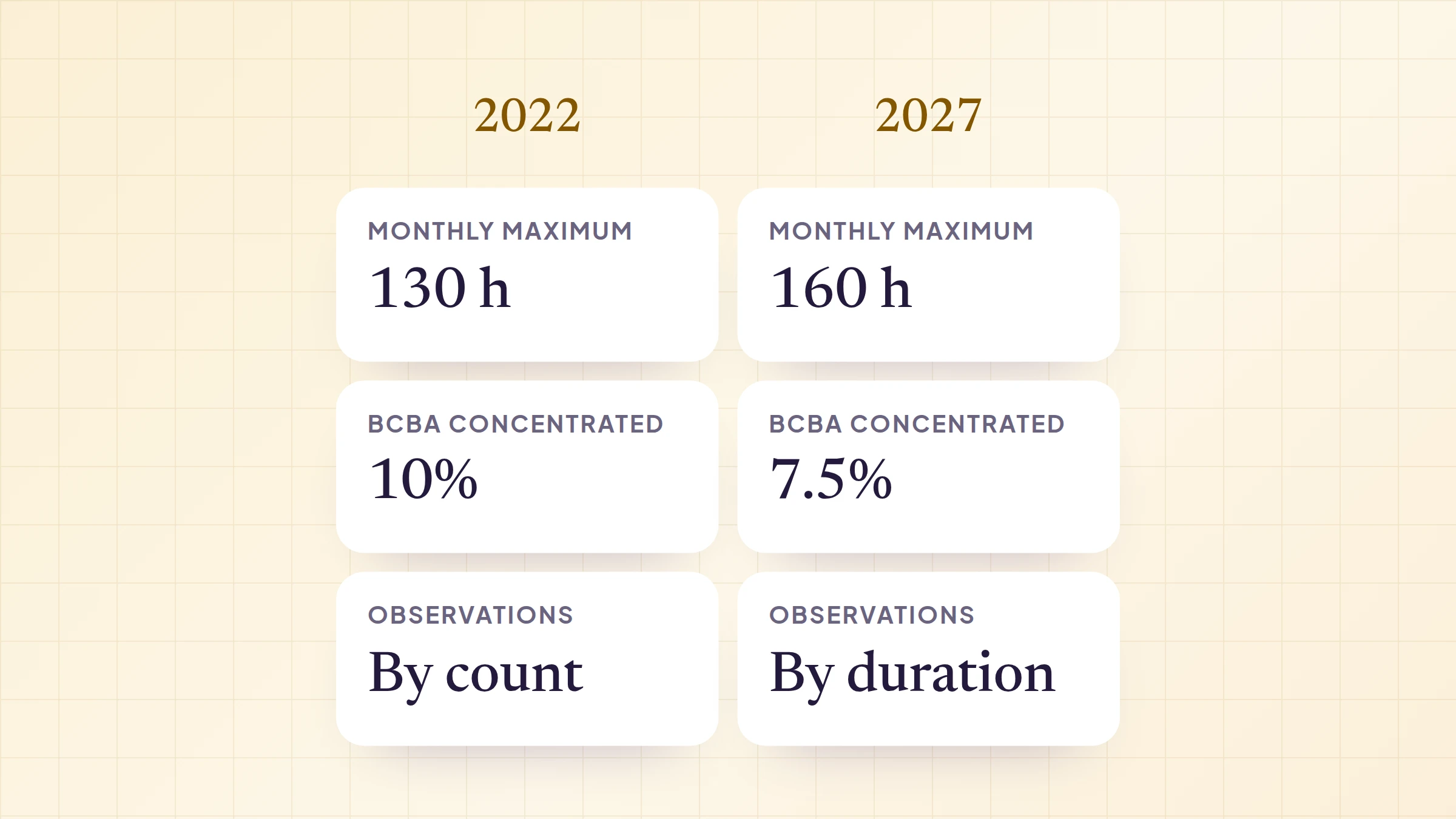
- Concentrated is shorter because it needs fewer hours. In exchange, more of each month must be supervised: 7.5% for BCBA and 10% for BCaBA, against 5% on supervised fieldwork. Our BCBA fieldwork requirements page has the full monthly rules for both types.
Already have hours logged, or a finish date in mind? The calculator starts from your hours completed and gives you an estimated completion month.
See each month as you log it.
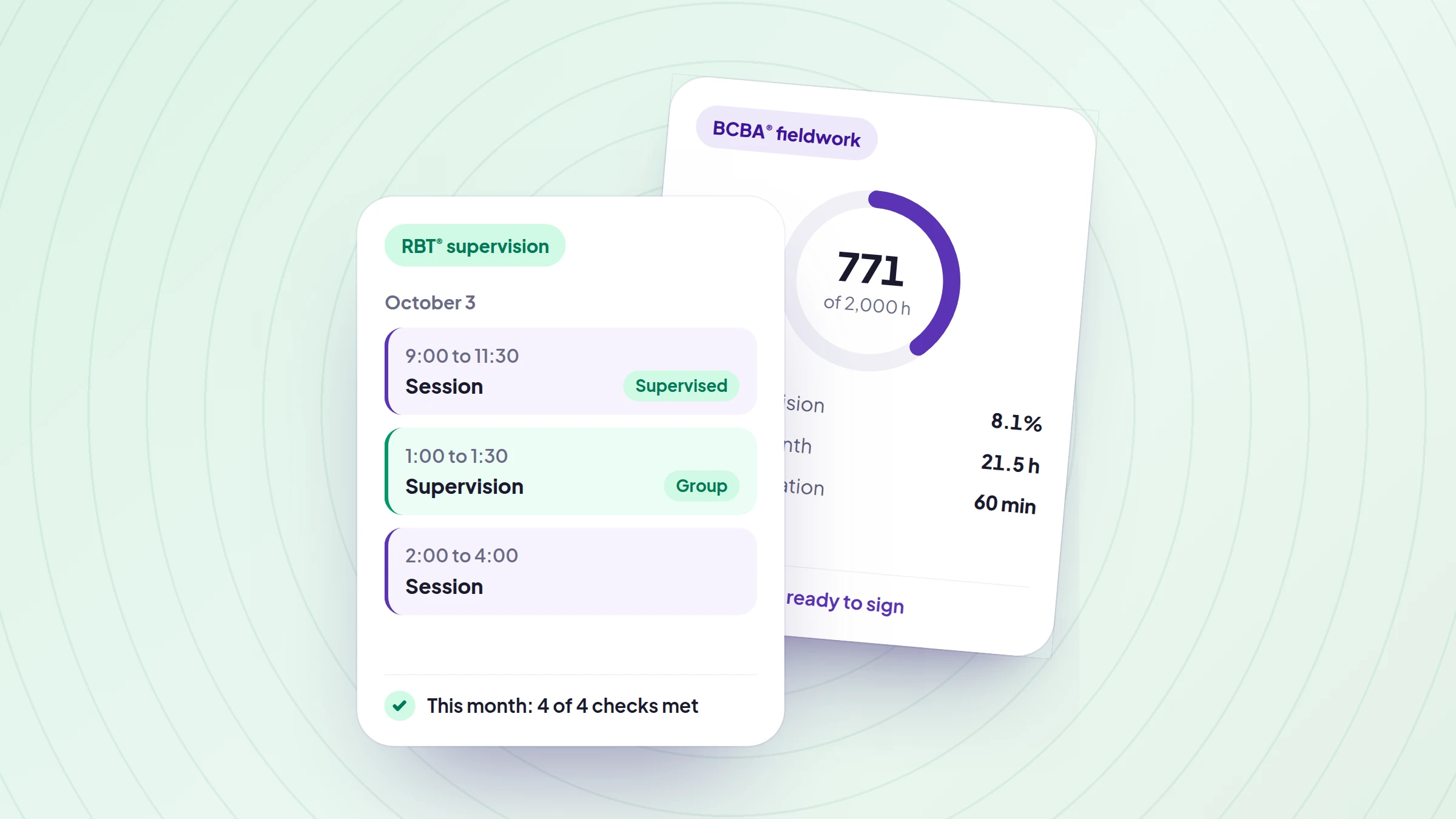
ABA Fieldwork Tracker shows every month's supervision percentage as you log and handles supervised and concentrated months automatically, under pre-2027 or 2027 rules. Free, with no ads.
Why the month is the unit: 20 to 160 hours#
Fieldwork timelines are built from calendar months because that is how the requirements are measured. Each month, which the BACB calls the supervisory period, needs at least 20 fieldwork hours, and no more than 160 hours count under the 2027 standards.
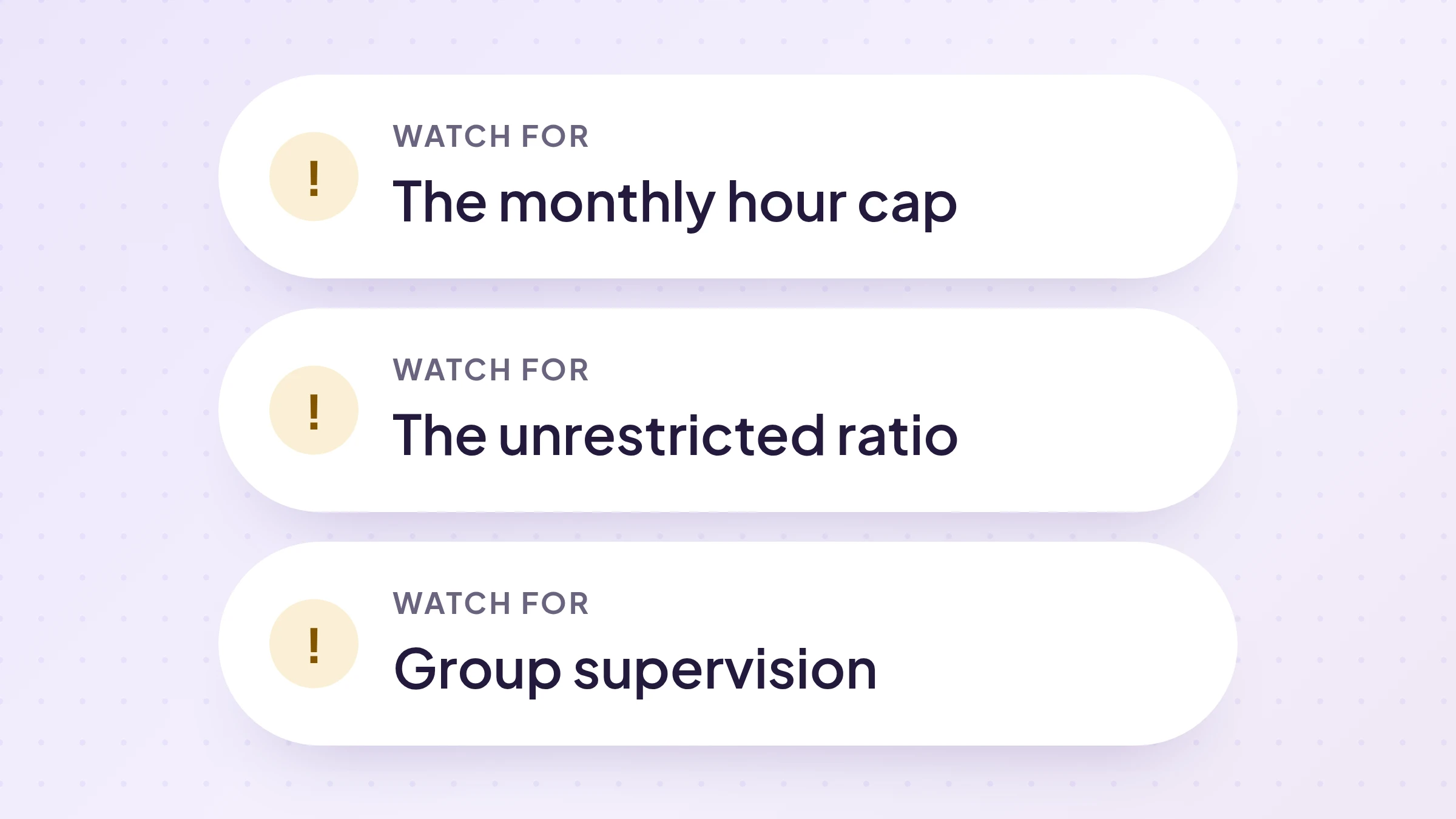
- Under 20 hours, the month counts for nothing. The Handbook’s adjustment table is plain about it: for “Fewer than 20 total hours,” “No hours are eligible for the month.” A 15-hour month doesn’t count as 15. It counts as zero. That is the 20-hour monthly minimum.
- Over 160 hours, the extra hours don’t count. A heavy month can’t make the timeline shorter than 160 hours a month allows.
- Under the pre-2027 standards, the cap is 130. That is why older guides quote longer minimums: 2,000 hours at 130 a month take 16 calendar months, not 13.
Which standards your fieldwork is judged under is decided by your completed application, not by when your fieldwork started. If you are starting fieldwork in October 2026 or later, plan with the 2027 numbers in this guide. Our BACB requirement changes page has the dates and the details of the switch, and 2022 vs. 2027 BACB standards walks through what changed.
Five continuous years, counted by calendar month#
The other limit is the fieldwork window. The Handbook says fieldwork “must be completed within five continuous years,” and adds: “The five years are calculated by calendar month, not date-to-date.” Its own example runs from May 1, 2020, to April 30, 2025: 60 whole calendar months.
The Handbook’s example is a fixed span of calendar months, May 2020 to April 2025, and neither Handbook describes a pause or an extension. So plan as if the window keeps running through the months you don’t log: a summer off, or a month under 20 hours, still uses one of the 60. The BACB’s slowest paces match that arithmetic: about 34 hours a month fits 2,000 hours into 60 months.
Planning a break? The Handbook has a note for that too: “Taking a break from accruing fieldwork under the same supervision contract constitutes a new supervision experience.” The note sits in the Handbook’s section on Fieldwork Verification Forms, right after the sentence on the Final Fieldwork Verification Form, which is completed at the end of each fieldwork experience. The Handbook lets one application carry several of them. Agree with your supervisor how a break will be documented before you take it.
Why 14 hours a month isn’t a real pace#
Back to the footnote. For BCaBA concentrated supervised fieldwork, 800 hours, the Tip Sheet’s longest time frame is “5 years” at “~14 hours per month.” That matches 800 divided by 60 months, rounded up. But the same page reminds you that “each month, you must complete a minimum of 20 hours,” and a month under 20 earns no eligible hours. Fourteen hours a month, every month for five years, would count for nothing.
So for BCaBA concentrated fieldwork, the slowest steady pace that counts is 20 hours a month: 800 hours in 40 months, or 3 years and 4 months. You can spread the work over more of the five years, but not evenly. Every month you want counted needs 20 hours or more, and the months in between still pass on the calendar.
The other three pathways reach the five-year limit before they reach the floor:
| Pathway (2027 total) | The Tip Sheet’s five-year pace | At least 20 hours a month? | At exactly 20 hours a month |
|---|---|---|---|
| BCBA supervised (2,000 h) | ~34 hours per month | Yes | 100 months (8 years, 4 months): past five years |
| BCBA concentrated (1,500 h) | 25 hours per month | Yes | 75 months (6 years, 3 months): past five years |
| BCaBA supervised (1,300 h) | ~22 hours per month | Yes | 65 months (5 years, 5 months): past five years |
| BCaBA concentrated (800 h) | ~14 hours per month | No: a month under 20 hours earns no eligible hours | 40 months (3 years, 4 months): inside five years |
In short: for three pathways the five-year window sets the slowest pace, and for BCaBA concentrated fieldwork the 20-hour floor does.
What stretches a timeline#
The tables assume every month counts in full. Real fieldwork has gaps, and most of them can be planned around:
- Time off. Holidays, vacations and illness, which the BACB’s own table leaves out. Nothing in the Handbooks pauses the five-year window while you’re away.
- Quiet months. A month under 20 hours counts zero, so plan exam season and the holidays to reach 20.
- Short supervision. The supervision percentage is checked inside each calendar month. On supervised fieldwork, the Handbook lets you “decrease the independent hours for the month until the % of supervision meets (or exceeds) the minimum monthly requirement,” so a short month keeps part of its hours. On concentrated supervised fieldwork, “concentrated hours may not be prorated or adjusted.”
- A late signature. Each Monthly Fieldwork Verification Form has to be signed by you and your supervisor by the last day of the following calendar month, or no hours are eligible for that month.
We cover these and a few more in seven fieldwork compliance mistakes that cost candidates months.
Mixing supervised and concentrated months#
You don’t have to stay with one fieldwork type. One application can combine supervised and concentrated months. The BACB’s fieldwork FAQ says each month’s type is decided on its Monthly Fieldwork Verification Form: “If the higher requirements for concentrated supervised fieldwork are met for the month, the hours may be counted as concentrated supervised fieldwork.”
For BCBA, the BACB puts concentrated hours at “approximately 1.33 times the temporal value” of supervised hours toward the total, and every form still records the actual hours you worked. On a timeline, a mixed BCBA plan at 160 hours a month lands between the two pure cases, at 10 to 13 calendar months. In ABA Fieldwork Tracker, each month keeps its own type, so a change partway through just works. More in our FAQ on combining supervised and concentrated fieldwork.
What this guide doesn’t count#
Fieldwork is one part of becoming a BCBA. This guide doesn’t estimate your degree, your coursework, how long the BACB takes to process an application, or when you can sit the exam, because those depend on your program and on the BACB rather than on arithmetic. A single number for the whole path hides the parts that vary most. Your program can speak to coursework, and the BACB to applications and the exam. For every requirement on your pathway, start from the BACB pathway pages.
Plan it, then track it#
Pick a pace you can hold in your hardest month, not your best one, and check it against the tables above. Then put your own numbers into the fieldwork hour calculator for an estimated completion month. Once you start logging, ABA Fieldwork Tracker shows each month’s supervision percentage as you go, tracks observation minutes under the 2027 rules, handles supervised and concentrated months automatically, and takes your Monthly and Final Fieldwork Verification Forms through your supervisor’s review and signature. It’s free, with no ads. Register for free and log your first month.
ABA Fieldwork Tracker is an independent tool and is not affiliated with or endorsed by the Behavior Analyst Certification Board®. Always consult the current BACB® Handbook and your supervisor for authoritative guidance on fieldwork requirements.