 ABA Fieldwork Tracker

The short answer#
You passed the exam, your certification is active, and a trainee or an RBT® is already asking whether you can supervise them. Here is how to become a BCBA supervisor in four steps, and what to have in place before the first supervised hour. Every requirement below comes from the BACB®‘s own documents, named with their revision dates, so you can check each one yourself.
- Meet the supervisor qualifications: an active BCBA® certification (the BCBA-D® designation included) with no current disciplinary sanctions.
- Complete the 8-hour supervision training and upload it to your BACB account.
- In your first year of certification, meet a consulting supervisor in each month you supervise fieldwork trainees.
- Keep your supervision CEUs current.
Then, for each fieldwork trainee, sign a written supervision contract before any hours start, and put the monthly signing deadline on your calendar. The checklist at the end puts it all on one page.
Step 1: meet the supervisor qualifications#
The BCBA Handbook (updated 06/2026) sets the test for fieldwork supervisors. You must be “an active BCBA with no current disciplinary sanctions,” meet the ongoing supervision CEU requirement, and either have been certified for at least one year or be receiving monthly consultation from a qualified consulting supervisor. The BCBA-D is not a separate certification, so the same rules apply to it.
Three more conditions shape who you can take on:
- No conflicting relationship. During the fieldwork period you may not be related to, subordinate to, or employed by the trainee, or be in a multiple relationship with them. A trainee paying you for supervision does not make you their employer.
- A link to the clients. All supervision must relate to specific client programming, and the BACB’s supervisor checklist asks you to confirm a direct relationship with, or oversight of, the clients the trainee serves.
- Competence and capacity. The Ethics Code for Behavior Analysts asks you to “provide supervision only after obtaining knowledge and skills in effective supervisory practices” (4.02), and to take on only as much supervision as you can do well (4.03). How many RBTs a BCBA can supervise does the math for a whole caseload.
Trainees choosing a supervisor check the same list (see how to find a BCBA supervisor). The glossary keeps the short version of what a qualified supervisor needs.
Step 2: complete the 8-hour supervision training#
Before you supervise anyone, whether fieldwork trainees, BCaBAs® or RBTs, you need an 8-hour supervision training based on the BACB’s Supervisor Training Curriculum Outline (2.0). The Outline (version 05/2026) sets the rules for the training itself:
- Authorized Continuing Education (ACE) Providers may offer it.
- It adds up to at least 8 hours, in units as short as 1 hour, in person or online.
- It must give you chances to show what you learned.
- It covers two areas: supervising ongoing services, and supervising trainees.
You do not have to wait for your certificate. The Outline lets you complete the training up to 180 days before your original BACB certification date, so it can be done before you are certified.
When you finish, the provider gives you a one-page completion document. Upload it to your BACB account; once it is approved, and your other requirements are met, you may begin supervising. For fieldwork, the Handbook says to upload it before you sign a supervision contract. The BACB Certificant Registry then lists you with “Completed supervision training on” and a date, which the Handbook calls the date you became eligible to provide supervision. Trainees are told to check that line before they sign, so expect them to look.
Every such training must carry one line: it “is based on the BACB Supervisor Training Curriculum Outline (2.0) but is offered independent of the BACB.” The Handbook points to the BACB’s ACE Provider Directory for providers; we do not recommend any.
Step 3: your first year and the consulting supervisor#
If you supervise trainees accruing fieldwork toward BCBA or BCaBA certification during your first year of certification, you need a consulting supervisor. The BACB’s Consulting Supervisor Requirements for New BCBAs Supervising Fieldwork (updated 03/2026) set out how it works. You do not need one to supervise RBTs or BCaBAs, or in a month when you supervise no trainees.
Who can consult. Your consultant is an active BCBA with no disciplinary sanctions, certified for at least five years, meeting the supervision CEU requirement, who completed the 8-hour training before consulting. They may not be related to, subordinate to, or employed by you, and paying them for consultation does not make them your employee. They can work at your organization or at another one.
The meeting. At least 1 hour a month, synchronous and one-on-one (meeting online is allowed), until you have been certified for one year. You can have more than one consultant, and switch if one becomes unavailable. A written consultation contract is “strongly encouraged.” The consultant does not need to be on your trainee’s contract or to meet your trainee; the consultation is between the two of you. Topics might include supervision contracts, a supervision curriculum, time management systems, and evaluating the effects of your supervision.
The record. Each consultation goes on the BACB’s own documentation form; other forms are not accepted. Each month’s row is signed by the last day of the calendar month after the consultation, and you and your consultant keep the form for seven years. It may be requested in an audit.
A missed month. The BACB says a missed consultation “will not affect the trainee’s supervised fieldwork hours.” It may lead to a Notice of Alleged Violation and to restrictions on your supervising or your certification, so give it the same place on your calendar as any other monthly deadline.
The same rule applies to a BCaBA who becomes a BCBA, for their first 12 months as a BCBA, and to anyone who qualifies again via past certification. The Handbook’s own advice is worth repeating: “We highly recommend waiting until after you have ample experiences of your own before you supervise others.”
Step 4: keep your supervision CEUs current#
Every BCBA completes 32 CEUs in each two-year recertification cycle. If you supervised RBTs, BCaBAs or fieldwork trainees at any point in the cycle, some of those must be supervision CEUs, covering the practices in the Supervisor Training Curriculum Outline (2.0). How many depends on which document you read:
- The BCBA Handbook (updated 06/2026): three supervision CEUs.
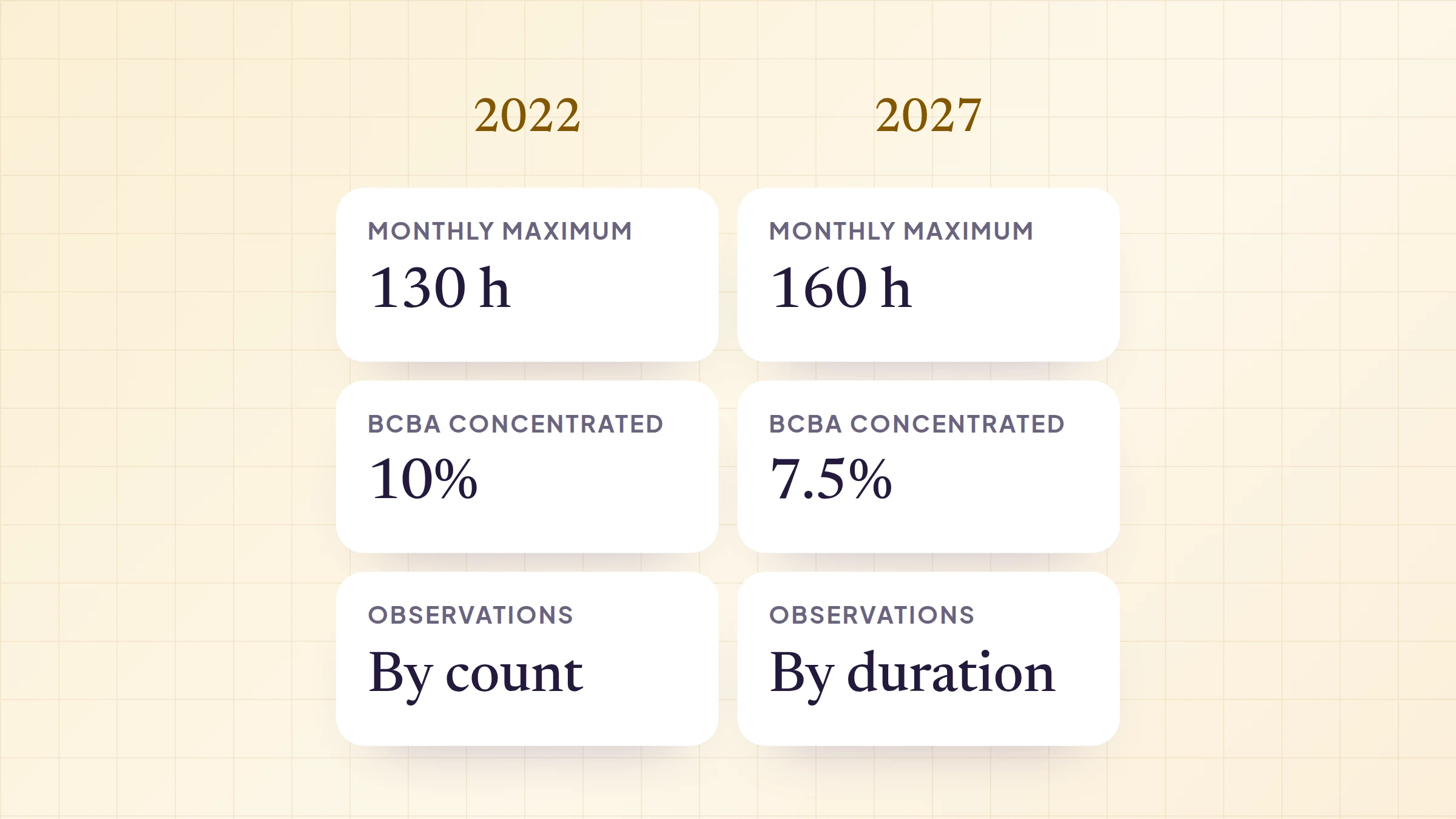
- The 2027 BCBA Requirements (updated 02/2026): four, among the changes that take effect on January 1, 2027. The March 2025 BACB Newsletter lists continuing education among them.
The March 2022 BACB Newsletter, which first announced the fourth supervision CEU, said BCBAs recertifying on or after January 1, 2027 must meet the new continuing education requirements. It now carries a note that some of its information is outdated, and points to the 2027 Requirements as the definitive source. If your recertification date falls on or after January 1, 2027, ask the BACB which number applies to you before you recertify.
Our reading, not a BACB rule: the Handbook counts supervision CEUs within the 32 (its word is “including”), so a fourth supervision CEU uses one of your 32 rather than adding one. The Handbook is clear that CEUs beyond the requirement do not carry into the next cycle, and the BACB’s supervisor checklist says supervision CEUs “are required to remain eligible to supervise and recertify.” For the other changes arriving on January 1, 2027, see every BACB change, dated.
Who you can supervise once you qualify#
A qualified BCBA can supervise three groups: fieldwork trainees working toward BCBA or BCaBA certification, RBTs, and BCaBAs, who practice under a BCBA’s supervision. The Handbook’s role table asks for the 8-hour training and supervision CEUs for all three, and a consulting supervisor in your first year only for trainees. You can start supervising any of them as soon as you are certified and have met the other requirements, such as the training.
For RBTs there are two roles. A BCaBA can also be an RBT Supervisor, but only a BCBA can be an RBT Requirements Coordinator. The two roles are explained in who can supervise an RBT.
Before the first hour: the supervision contract#
No fieldwork hours count until the trainee has a qualified supervisor and a signed contract with each supervisor, and developing and executing that contract is the supervisor’s job. The Handbook says the contract should include:
- each party’s responsibilities, including your completed 8-hour training and everyone’s adherence to the fieldwork requirements;
- when several supervisors at one organization share a trainee, each supervisor’s role, responsibilities and expectations, including how documentation and forms will be completed (one contract signed by all may be used);
- activities and training objectives individualized to the trainee;
- the objective, measurable circumstances in which you will not sign the monthly or final verification form;
- what happens if a party does not keep to their responsibilities, including how the relationship is properly ended;
- the trainee’s written permission from their on-site employer or manager, when that applies;
- an attestation that everyone will follow the Ethics Code;
- that you and the trainee keep the contract and supervision documentation for at least seven years from the final supervision meeting, and provide it to the BACB if asked.
Amendments are fine, as long as everyone involved signs and dates each one. The BACB publishes a Sample Supervision Contract for BCBA/BCaBA Trainees you can start from, and the Handbook requires a contract for the BCaBAs you supervise as well.
For RBTs, the Handbook does not require a contract, though it calls clear expectations valuable in any supervisory relationship. What you do need is the RBT listed as your supervisee in your BACB account while you supervise them (or listed by their RBT Requirements Coordinator), and an RBT Supervisor or Coordinator in place for every client the RBT works with.
What you owe each month: trainee vs RBT#
Fieldwork builds toward a total and ends with a final form. RBT supervision repeats every month and has no finish line. Here is what each asks of you in a month.
| Fieldwork trainee (BCBA or BCaBA) | RBT | |
|---|---|---|
| Before the first hour | A written supervision contract signed by every party; no hours count before it | No contract required by the BACB; the RBT listed as your supervisee in your BACB account |
| Your training | 8-hour training uploaded before you sign the contract | 8-hour training completed before you supervise |
| In your first year | A consulting supervisor, at least 1 hour in each month you supervise trainees | Not required |
| How much supervision | 5% of the trainee’s fieldwork hours that month on supervised fieldwork. Concentrated: 10% under the pre-2027 standards; under the 2027 standards, 7.5% for BCBA and 10% for BCaBA | At least 5% of the RBT’s behavior-analytic service hours that month |
| Worked example | 120 fieldwork hours: at least 6 supervised hours at 5%, 9 at 7.5%, 12 at 10% | 80 service hours: at least 4 hours supervised |
| Meetings | Pre-2027 standards: at least four contacts (supervised) or six (concentrated). 2027 standards: the requirement tables and the 2027 M-FVF carry no contact count, and the March 2022 BACB Newsletter announced its elimination; the Handbook’s Structure of Supervision section still prints four and six | At least two real-time, face-to-face contacts (in person or live video); phone and email do not count |
| Individual and group | At least half of supervision meeting time individual, and group hours no more than half of total supervised hours (the Handbook states both); groups of 2 to 10 trainees | At least one of the two contacts individual; the other may be a small group of 2 to 10 RBTs |
| Observation | Pre-2027 standards: at least one observation with a client each month. 2027 standards: 60 minutes, added up across the month (supervised) or 90 (concentrated) | Observe the RBT with a client in at least one of the monthly contacts (live video is allowed); video monitoring on its own, without real-time interaction or feedback, may not count as supervision |
| More than one site | One M-FVF per supervisor or per organization each month | Requirements met separately at each organization, never pooled |
| Forms | M-FVF signed by trainee and supervisor by the last day of the following month, or that month’s hours are not eligible; F-FVF at the end of the relationship | No BACB monthly form and no BACB signing deadline; the record shows service days and times, supervision dates and durations, format, observation dates, supervisor names, and your relationship to the client |
| Records | Both keep fieldwork documentation at least seven years | Both keep supervision records at least seven years |
| Your CEUs | Supervising a trainee at any point in a cycle makes supervision CEUs due that cycle | Supervising an RBT at any point in a cycle makes supervision CEUs due that cycle |
The Monthly Fieldwork Verification Form (M-FVF) must be signed by you and the trainee by the last day of the calendar month after the month of supervision, or no hours are eligible for that month. At the end of each supervision relationship you sign a Final Fieldwork Verification Form (F-FVF), which the trainee submits with their application. The BACB’s supervisor checklist is plain about what that means: “a signature is an attestation that all current BACB requirements have been met.”
From January 1, 2027, applications use the 2027 forms. If a trainee meets both sets of requirements and is unsure when they will apply, the BACB recommends completing both the 2022 and 2027 M-FVFs each month. If you are new to the 2027 rules, start with what changes in 2027; the BCBA pathway page sets out 2027 supervised fieldwork month by month.
For RBTs, the full RBT ongoing supervision rules are on one page, and the RBT supervision calculator works out the 5% for any month. An RBT month with no service hours owes no supervision.
Your first-supervisee checklist#
Becoming a BCBA supervisor is mostly done before anyone logs an hour. Work down this list once, and again before each new trainee. The BACB publishes its own Fieldwork Checklist for BCBA and BCaBA Supervisors (version 4/2026) and strongly encourages supervisors to complete it; ours adds the dates.
Before you say yes
- Your BCBA certification is active, with no current disciplinary sanctions.
- You are not related to, subordinate to, employed by, or in a multiple relationship with the trainee (being paid by the trainee for supervision is not employment).
- You have a direct relationship with, or oversight of, the clients the trainee will serve.
- You have the time: the Ethics Code asks you to take on only as much supervision as you can do well.
Training and uploads
- 8-hour supervision training completed, based on the Supervisor Training Curriculum Outline (2.0).
- Completion document uploaded to your BACB account and approved; the Certificant Registry shows “Completed supervision training on” with your date.
- For fieldwork, all of this is done before you sign the supervision contract.
Your first year (only if you take a fieldwork trainee)
- A consulting supervisor: active BCBA, no disciplinary sanctions, certified at least five years, current on supervision CEUs, 8-hour training done, and not related to, subordinate to, or employed by you.
- A consultation contract (the BACB strongly encourages one).
- At least 1 hour, synchronous and one-on-one (online is fine), in each month you supervise a trainee, until your first certification anniversary.
- The BACB consultation form, each month’s row signed by the last day of the following month, kept seven years.
For each fieldwork trainee
- A written contract covering every item the Handbook lists, signed by everyone before the first hour.
- A documentation system agreed with the trainee that records, for each supervision contact: date, start time, end time, fieldwork type, supervision type (individual or group), activity category (restricted or unrestricted), and a summary.
- Somewhere to keep it that you can still reach after you leave the job, for seven years (the BACB’s own example: “not on a work computer”).
- If the trainee meets both sets of requirements and is unsure whether they will apply before or after January 1, 2027, both the 2022 and 2027 M-FVFs each month, as the BACB recommends.
- An F-FVF signed at the end of each supervision relationship.
For each RBT
- The RBT listed as your supervisee in your BACB account (or by their RBT Requirements Coordinator).
- An RBT Supervisor or Coordinator in place for every client the RBT works with.
Every cycle
- Supervision CEUs: three under the BCBA Handbook (updated 06/2026), four under the 2027 BCBA Requirements (updated 02/2026).
Every month
- The signing deadlines below on your calendar. Your first-year consultation rows share the same deadline.
The rule: each month’s M-FVF is signed by the last day of the following calendar month.
| Month of supervision | Sign by | Day of week |
|---|---|---|
| October 2026 | November 30, 2026 | Monday |
| November 2026 | December 31, 2026 | Thursday |
| December 2026 | January 31, 2027 | Sunday |
| January 2027 | February 28, 2027 | Sunday |
| February 2027 | March 31, 2027 | Wednesday |
| March 2027 | April 30, 2027 | Friday |
| April 2027 | May 31, 2027 | Monday |
| May 2027 | June 30, 2027 | Wednesday |
| June 2027 | July 31, 2027 | Saturday |
| July 2027 | August 31, 2027 | Tuesday |
| August 2027 | September 30, 2027 | Thursday |
| September 2027 | October 31, 2027 | Sunday |
| October 2027 | November 30, 2027 | Tuesday |
| November 2027 | December 31, 2027 | Friday |
| December 2027 | January 31, 2028 | Monday |
Our advice, not a BACB rule: four of these fall on a weekend. The rule names the last day of the month and lists no weekend exception, so plan to sign the week before.
Keeping the monthly rhythm#
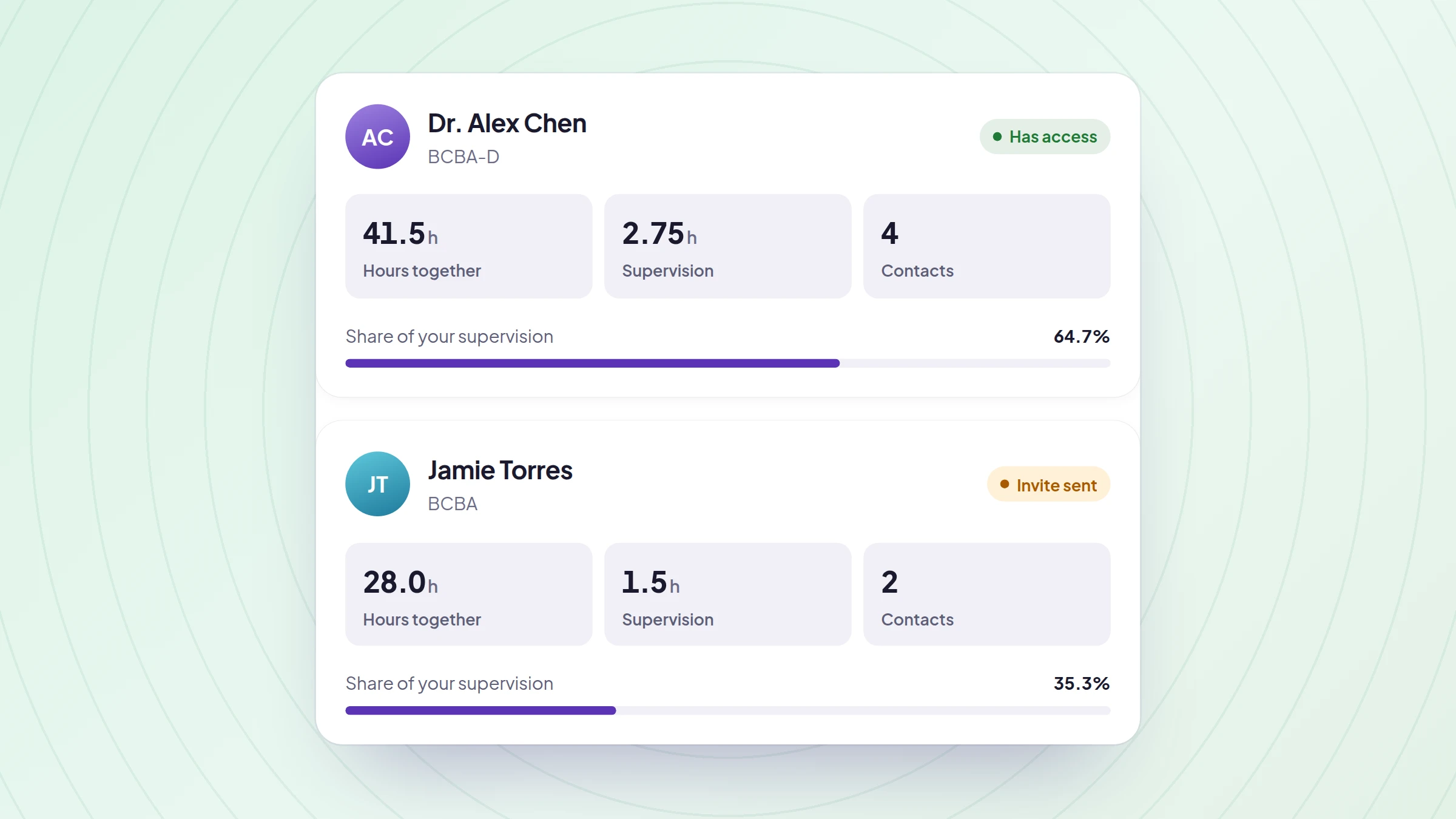
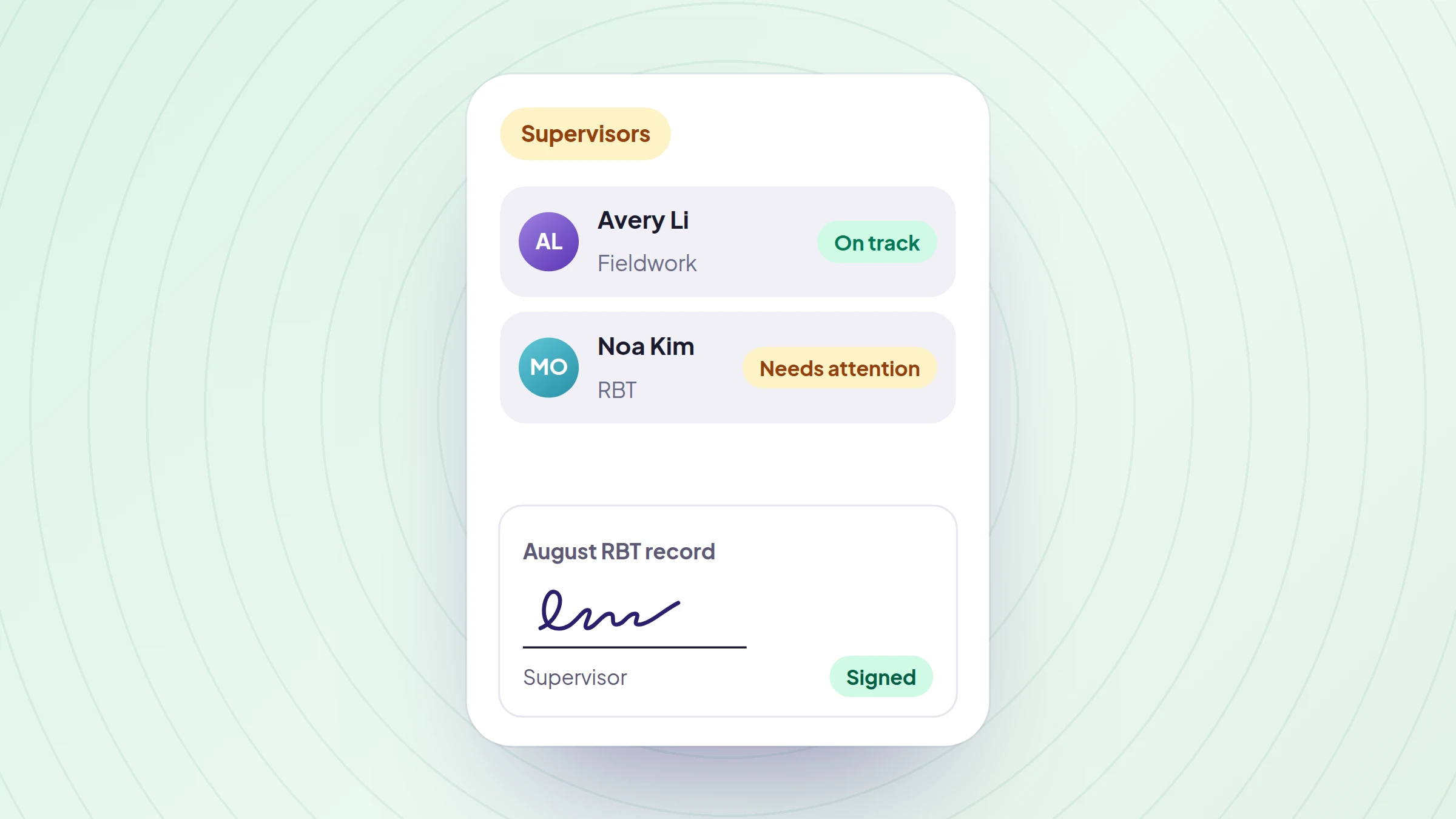
In ABA Fieldwork Tracker, each supervisee appears as a card with the current month’s numbers and a plain On track or Needs attention read, so a short month shows while there is still time to fix it. When you open someone’s records you see them read-only: viewing never changes what they logged. Monthly and final verification forms reach you in a signing queue, and the forms you sign stay on your Signed Forms page, even after you archive or disconnect a supervisee. The app shows where each month stands against the BACB requirements; the judgment, and the signature, stay yours.
Supervision runs on a monthly rhythm: see each person’s month while you can still act on it, sign on time, and keep what you signed. Supervisor accounts in ABA Fieldwork Tracker are free, however many people you supervise, and your fieldwork trainees and RBTs share one dashboard and one signing queue. Create your free supervisor account before your first trainee logs an hour, and connect with them from day one.
Ready for your first supervisee?
Free supervisor accounts, however many people you supervise. Fieldwork trainees and RBTs on one dashboard, with forms awaiting your signature first.
ABA Fieldwork Tracker is an independent tool and is not affiliated with or endorsed by the Behavior Analyst Certification Board®. Always consult the current BACB® Handbook and your supervisor for authoritative guidance on fieldwork requirements.